

TECHNOLOGICAL TRENDS SHAPING THE FUTURE OF NUCLEAR ENGINEERING
Anna Topal, an engineer at Energy Safety Group and a participant in specialised programmes organised by Argonne National Laboratory and Idaho National Laboratory in the United States and Ukraine, shares her perspective on the technological developments shaping modern nuclear engineering, advances in computational modelling and digital approaches, and the competencies required by the next generation of nuclear professionals.
The full article was first published by Uatom.org.
Nuclear energy is entering a period of nuclear renaissance. In Europe, conditions are being established to deploy small modular reactors (SMRs), while the United States is advancing new reactor technologies and regulatory licensing approaches. At the same time, nuclear fuel cycles, safety systems, and computational tools continue to evolve, while digitalisation and artificial intelligence gradually transform research and modelling approaches.
The potential applications of nuclear energy are also expanding. Alongside electricity generation, attention is growing on cogeneration, hydrogen production, supplying energy to large data centres, and other applications that could shape the role of nuclear technologies in future energy systems.
These developments are creating new demands for engineering competencies. In-depth specialisation remains fundamental to the profession, while understanding the interconnections between reactor technologies, the nuclear fuel cycle, modelling, safety, digitalisation and regulatory requirements is becoming increasingly important.
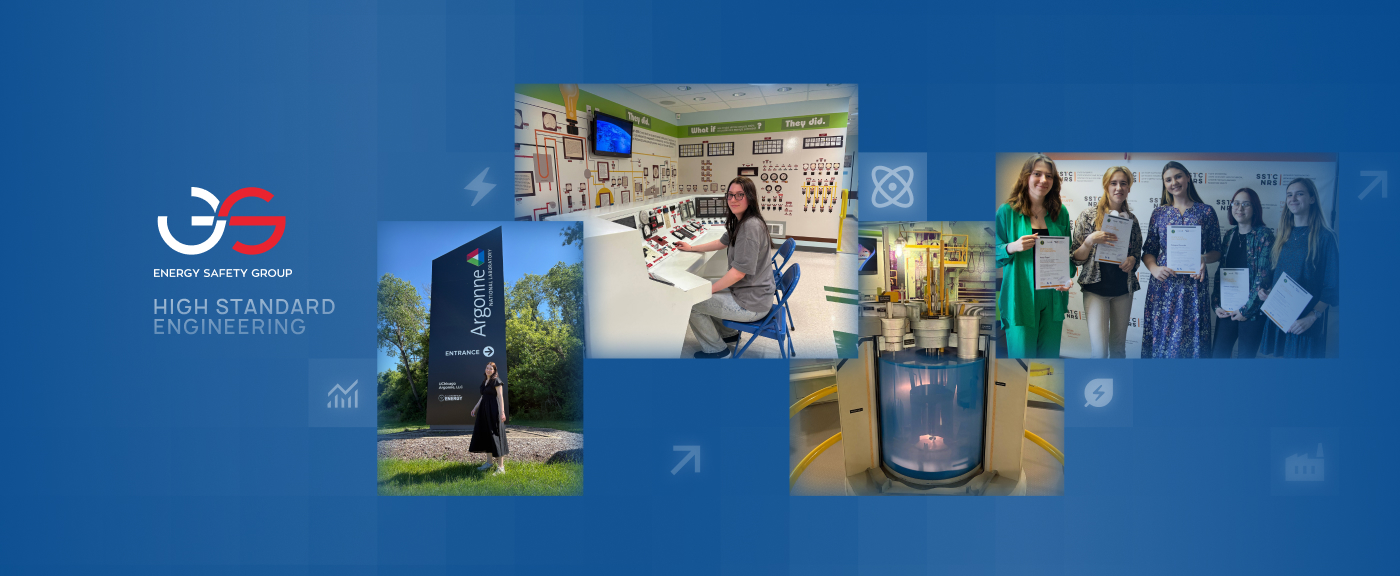
In the summer of 2026, I participated in two specialised educational programmes in the United States — The Small Modular Reactors (SMR) Summer School 2026 at Argonne National Laboratory (ANL) and MeV Summer School 2026 at Idaho National Laboratory (INL). These programmes let me explore the technological areas at the forefront of US nuclear research and development and better understand the issues likely to shape industry discussions in the coming years.
I also shared my impressions of the intensive training and experience I gained as a student in the Ukraine Summer Internship Argonne National Laboratory 2026 programme, which I attended in 2023. During our meeting, I shared my experience with advanced technologies at these leading US national laboratories. However, my main focus was on overcoming personal fears and stepping outside my comfort zone — particularly the challenge of delivering presentations in English to experienced industry experts. My key message to the students was to stay confident despite language barriers, embrace complex subjects and emerging fields still relatively new to Ukraine, and make the most of every opportunity. Sometimes, a single courageous step can shape an entire career.
From My First Summer School to a Career in Nuclear Engineering
My professional interest in emerging nuclear technologies began to take shape in 2023, when I participated in a summer school organised by ANL in cooperation with the State Scientific and Technical Center for Nuclear and Radiation Safety (SSTC NRS). At the time, I was in my fourth year of university and had my first opportunity to explore in detail the potential of using nuclear power plants for hydrogen production. The subject interested me so much that it eventually became the focus of my bachelor’s thesis.
My search for practical engineering expertise to support my thesis brought me to Energy Safety Group. Initially, I was looking for professional guidance and an opportunity to complete research practice. Over time, this interaction grew into a professional relationship with the company. Alongside my engineering work, I continued my education, completed my master’s degree and, this year, enrolled in a PhD programme to further combine practical engineering with scientific research.
Both programmes emphasised an international professional environment. The training brought together specialists from different countries, representing various fields of nuclear science and engineering. Discussions, knowledge sharing and opportunities to compare approaches to solving engineering challenges helped me gain a broader perspective on the technological developments and challenges currently facing the industry.
Access to such educational and research opportunities is particularly valuable for Ukrainian professionals. Support from ANL and INL, together with Energy Safety Group’s commitment to creating opportunities for its employees‘ professional development, enabled me to participate in these programmes and further strengthen competencies directly relevant to my engineering work. This experience also reinforced my appreciation of a professional environment where I can combine practical engineering responsibilities, academic studies, and participation in international programmes.
Technologies Reshaping the Architecture of Nuclear Energy
The ANL and INL programmes offered an opportunity to explore nuclear energy development from two interconnected perspectives. Much of the ANL programme focused on fast reactors, the nuclear fuel cycle, advanced fuel types, safety characteristics and the prospects for deploying advanced reactors. The INL programme placed greater emphasis on computational modelling, experimental validation, safety analysis, digital technologies and regulatory approaches. Together, these perspectives provide a broader understanding of how emerging reactor concepts are being developed as part of an integrated technological system, in which reactor design is closely linked to fuel, experimental infrastructure, computational methods, safety and future operating models.
One area I explored most deeply at ANL was fast reactors and their relationship to the nuclear fuel cycle. These technologies have a strong historical foundation: EBR-I generated the first usable electricity from nuclear energy in the United States in 1951; EBR-II operated from 1963 to 1994; and cumulative global operating experience with experimental and prototype fast reactors exceeds 400 reactor-years. Today, interest in these technologies is growing in a new context, driven by more efficient use of nuclear materials, fuel cycle management, the development of advanced fuels and next-generation reactor technologies.
In fast reactors, fuel and fuel-cycle considerations are closely linked to reactor physics and design. In an open fuel cycle, spent nuclear fuel cools for a period before further storage and eventual disposal. A closed fuel cycle involves reprocessing spent fuel to recover uranium and transuranic elements for reuse. This approach can improve nuclear material utilisation efficiency and change the characteristics of the remaining waste requiring final disposal.
EBR-II provides a practical illustration of the relationship between reactor technology and the fuel cycle. During the programme, more than 150,000 metallic fuel elements were irradiated, while reprocessing technologies were demonstrated for approximately 35,000 elements. Current research into fast reactor fuels includes metallic fuels, mixed oxide fuels, and nitride and carbide compositions. Researchers assess these for performance under operating conditions, recycling potential, manufacturability, and safety characteristics.
Another important topic was the safety of sodium-cooled fast reactors. Sodium’s properties and the system’s low-pressure operation create a different engineering framework than light-water reactors. Modern designs place considerable emphasis on natural coolant circulation, passive decay heat removal and the system’s substantial thermal inertia. At the same time, the transition from experimental facilities to commercial deployment requires a robust safety case, specialised equipment, qualified supply chains and appropriate regulatory expertise.
Another major focus of the ANL programme was developing small modular reactors (SMRs). Their potential role extends well beyond reducing an individual reactor unit’s generating capacity. Modularity, phased capacity deployment, diverse reactor technologies, and a wider range of potential sites are changing approaches to nuclear power deployment. At the same time, SMR development presents the industry with a range of interconnected challenges, from safety demonstration and licensing of new designs to project economics, supply chains and infrastructure readiness.
The programme also explored how the functional role of SMRs and other advanced reactor technologies is evolving within energy systems. Beyond electricity generation, modern reactor concepts are being considered for industrial heat supply, hydrogen production, water desalination, powering large data centres, and operating within energy systems with a high share of renewable generation. For example, the Natrium concept combines a sodium-cooled fast reactor with a thermal energy storage system, decoupling stable reactor operation from variations in the power unit’s electrical output.
From Computational Models to the Evidence Base
Another overarching theme of both programmes was the evolving role of computational modelling. Emerging reactor technologies require tools for neutronics and thermal-hydraulic calculations, fuel and materials analysis, transient and accident simulations, and multiphysics modelling. However, greater model complexity does not automatically lead to more reliable results. The key question is how well we understand a model’s limits of applicability and what experimental evidence supports its predictions.
During the programmes, I paid particular attention to verifying and validating computational codes. Verification addresses whether the software correctly implements the mathematical model and its underlying algorithms. Validation assesses how accurately simulation results represent real physical processes and requires comparisons with experimental data, benchmark problems and other supporting evidence. This process also involves cross-validation, uncertainty quantification and comparisons between different computational codes.
RELAP5-3D, developed at INL, illustrates these principles. Many conventional thermal-hydraulic codes were originally developed and validated primarily for light-water reactors. When applied to other technologies, such as high-temperature gas-cooled reactors, the existing validation database must be assessed separately. This is particularly important for SMRs, which encompass a range of reactor technologies with potentially different coolants, fuels, design features and safety systems. Consequently, the applicability of computational codes and the adequacy of their validation databases must be evaluated for each specific technology. This involves using data from specialised experimental facilities, comparing results obtained with different computational codes, and assessing calculations against experimental measurements, including quantitative error analysis.
During the INL programme, we explored two of the laboratory’s more recent developments in considerably greater detail: the MOOSE computational framework and BISON, a fuel performance code built on MOOSE. MOOSE development began in 2008, providing a framework for multiphysics modelling of interconnected processes, while BISON, under development since 2009, focuses on predicting nuclear fuel performance during operation, including thermal behaviour, deformation, and irradiation effects. Comparing these tools with RELAP5-3D, whose development builds on computational programmes dating back to the 1960s, illustrates the evolution of computational approaches — from system-level thermal-hydraulic analysis to multiphysics models that capture interactions between different physical processes and material properties.
These examples highlight the close relationship between modelling, experimentation and validation. Computational codes predict plant behaviour under normal operating conditions, during transients, and in accident scenarios. They support engineering design and safety analysis and may contribute to the evidence base required for licensing. Confidence in computational results depends on the entire process — from the physical model and underlying assumptions to experimental testing, validation and uncertainty assessment.
This field is directly relevant to the Energy Safety Group’s work, where computational safety assessments and technical justifications are integral to engineering practice. The programmes therefore provided an opportunity to compare approaches used by international research institutions with the methods and engineering challenges our specialists encounter in their work.
Safety, Risk and Regulation of Emerging Technologies
Another important takeaway from the programmes concerns the evolving approach to nuclear safety analysis. At INL, we devoted considerable attention to the relationship between deterministic and probabilistic approaches. Deterministic analysis examines a facility’s physical behaviour, evaluates safety margins, and verifies compliance with safety criteria for specified events. Probabilistic analysis systematically assesses potential scenarios, their frequencies, consequences and associated uncertainties. In modern safety cases, these approaches complement each other.
This is particularly important for SMRs and other advanced reactor technologies. Traditional regulatory frameworks were largely developed around the operating experience of large light-water reactors, whereas modern SMR concepts encompass a variety of reactor technologies, coolants, fuel types, safety systems and power levels. This calls for approaches that account for each technology’s characteristics and its associated range of potential scenarios. In the United States, this transition is accompanied by the development of risk-informed, performance-based, and technology-inclusive regulatory approaches that assess system functions and safety significance in the context of specific reactor technologies.
The logic of risk-informed analysis particularly resonates with me: defining the facility and its hazards, developing potential scenarios, assessing their frequencies and consequences, identifying the necessary safety functions, and using this information to develop technical solutions and the supporting safety case. This approach focuses attention on the risks that need to be controlled and on demonstrating the effectiveness of the selected measures. It is directly relevant to the department where I work at Energy Safety Group, as the quality of safety justifications depends on how consistently input data, calculations, acceptance criteria and conclusions are linked.
At the same time, the concept of safety extends beyond reactor physics and thermal hydraulics. The programme also covered physical protection, cybersecurity, and the use of digital tools to monitor and assess system conditions. For modern nuclear facilities, nuclear and radiation safety, nuclear security and cybersecurity are becoming increasingly interconnected. Digitalisation creates new opportunities for analysis and automation while introducing additional dependencies and protection requirements.
I was particularly interested in the discussions on artificial intelligence. In the nuclear sector, people are already exploring its potential applications in large-scale data analysis, computational modelling, equipment condition prediction, computer vision, and operator training. However, these opportunities also raise questions about the verifiability of results, data quality, cybersecurity, the limits of automation, and human responsibility for decision-making. In my view, these issues will become a major focus of professional discussion in the coming years, particularly in an industry where decisions must be supported by rigorous evidence.
Engineering Competencies in a New Technological Era
These programmes have given me an even clearer understanding of how advances in nuclear technology are changing the competencies required of engineers. In-depth specialisation remains fundamental: working effectively in reactor physics, thermal hydraulics, structural integrity, probabilistic safety assessment, or nuclear fuel requires a strong knowledge foundation and extensive practical experience. At the same time, understanding how one’s work relates to other elements of the safety case and the broader technological system is becoming increasingly important.
Engineers using computational codes need to understand the physics underlying their models, the assumptions involved, the validation database, and associated uncertainties. Specialists developing new reactor concepts must consider fuel, materials, experimental data, manufacturing capabilities, licensing and physical protection. Working with digital technologies and artificial intelligence also requires a clear understanding of their limitations in systems where engineering decisions must be traceable and supported by evidence.
For the next generation of nuclear professionals, these developments are creating a more complex but also more engaging professional environment. We enter the industry equipped with digital tools, new modelling methods and faster access to information, while building on decades of operational, experimental and engineering experience. The challenge is to preserve this knowledge and apply it to developing new technologies.
Participating in the ANL and INL programmes let me see these connections firsthand — from the history of EBR-II and experimental facilities to advanced reactor technologies, multiphysics modelling, risk-informed regulation, and discussions on artificial intelligence. At Energy Safety Group, knowledge and experience sharing is an established part of our professional culture. After returning, I conducted a dedicated seminar for my colleagues, presenting the key technological areas covered by the programmes and sharing specialised materials with experts from the relevant departments. I consider this an important part of professional development: newly acquired knowledge can be applied within the team and serve as a foundation for further technical discussions.
Nuclear engineering has always required new solutions to be grounded in evidence, accumulated experience, and responsibility for outcomes. Technologies are evolving, tools are becoming more sophisticated, and the boundaries between individual disciplines are expanding. For engineers, this means continuously deepening their specialisation while learning to understand the system as a whole — from the physics of a process to how its results are verified, justified and applied in practice.
The opportunity to pursue this development while working on real engineering projects, continuing academic studies, and participating in international programmes depends largely on the professional environment. In my case, Energy Safety Group has provided that environment — supporting professional growth, encouraging individual initiative and creating opportunities to bring newly acquired knowledge and experience back to the team.