

From preliminary analytical justification to implementation: Energy Safety Group’s solutions for major incident management at ERMSAR 2026
When investigating severe accidents at nuclear power plants, there is one fundamental principle: between the initial design model and the actual safety system lie years of engineering work, testing, compromises and technical solutions. At the same time, the process is not limited to calculations or design documentation. It involves a complete cycle — from analytical justification and design to interaction with the operating organisation, compliance with regulatory procedures, management of equipment supply, installation, and commissioning of systems for trial and commercial operation. Therefore, what works well according to the completed calculation and analytical justification still has to prove its effectiveness under the real-world operating conditions of a power unit, structural constraints, and scenarios in which the equipment must continue to operate even when some systems are no longer available.
At the same time, nuclear safety has never been solely an internal matter for any single country. In the event of a serious accident, the consequences do not stop at national borders, and radiation does not require permission to cross them. It is therefore critically important for the nuclear industry both to develop its own technologies to ensure and enhance safety, and for the professional community to be able to openly share experience, research findings and engineering expertise — particularly when it comes to scenarios that could become reality but are unlikely to occur.
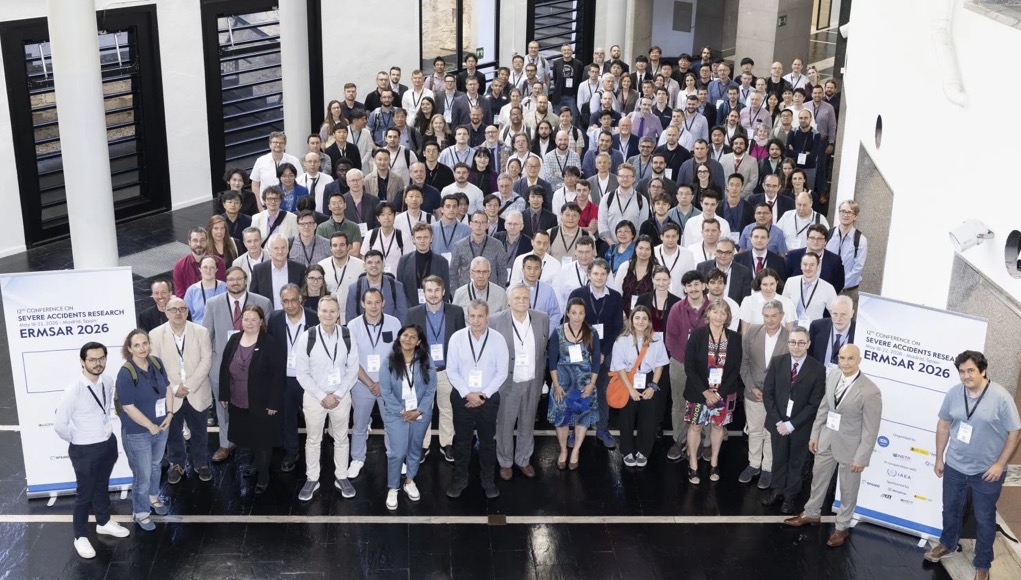
One such professional forum is ERMSAR (European Review Meeting on Severe Accident Research) — a key European conference dedicated to research into severe accidents at nuclear power stations. In 2026, the conference took place for the 12th time, further confirming its status as one of the leading professional forums in severe accident management and post-accident safety. Here, scientific hypotheses are tested against engineering practice, and professional discussions often lead to solutions that are subsequently implemented at actual power units.
Following the 2011 accident at the Fukushima Daiichi nuclear power plant, the global nuclear industry entered a new phase in the development of safety standards. Some scenarios that were previously considered unlikely began to be analysed as realistic possibilities. There was a demand for solutions that could operate even under the worst-case conditions, such as a complete power failure at the plant or a loss of cooling in the reactor core.
For engineering companies working on the safety of operational power units, professional conferences provide a forum for peer review of solutions. Presenting the results of implemented systems, discussing engineering approaches with the international professional community, and receiving critical questions and comments that help identify new avenues for improvement are important parts of technological development in nuclear safety. At the same time, such platforms provide an opportunity to familiarise oneself with the latest research and practical developments from other teams, understand how the industry is responding to new challenges, and integrate the most relevant approaches into one’s own engineering solutions.
With this focus, Energy Safety Group participated in ERMSAR 2026, held in Madrid from 18 to 22 May. The company’s team presented the results of implemented solutions and ongoing engineering developments for VVER-type reactors, developed in collaboration with international partners and aimed at improving the resilience of nuclear power units in severe-accident scenarios. The focus is on systems already being implemented at operating power units, as well as concepts currently undergoing analytical justification and professional discussion.
The Energy Safety Group delegation comprised Oleksandr Mazurok, CTO; Oleksandr Mykhailenko, Head of the Thermal-Hydraulic Analysis Group; and Yuriy Vorobyov, Senior Engineer in the Thermal-Hydraulic Analysis Group. During the conference, the team presented three technical posters in the poster session, as well as a separate presentation on the analytical justification of long-term post-accident cooling systems for VVER-1000 reactors.
One of the solutions presented was a poster entitled «Additional Primary Depressurized Line (APDL) for NPP Units with VVER-440/V-213», prepared in collaboration with the Slovak company VÚEZ, a.s. The development focuses on an auxiliary primary circuit depressurisation line for power units with VVER-440/V-213 reactors — a solution that reduces reactor pressure during a severe accident, even in the event of complete loss of power unit power. A distinctive feature of the APDL is its ability to maintain long-term decompression without a continuous power supply to the main valves, thereby creating the conditions necessary for the stable operation of the reactor vessel external cooling system (RVECS). The analytical justification demonstrated the solution’s ability to maintain the required target parameters at levels necessary to ensure safety, even under conservative severe-accident scenarios. The system is currently being installed at the power units of the Rivne NPP.
The second poster — «Implementation and Analytical Justification of Long-Term Containment Cooling System with Additional Spray Circuit, Heat Exchangers, and Turbine-Driven Pumps for NPPs with VVER-440 Reactors» — was dedicated to the long-term heat removal system from the containment for power units No. 1 and No. 2 of the Rivne NPP, developed and implemented in collaboration with Westinghouse Electric Company. The solution enables temperature and pressure control in the containment for up to six months, even in the event of a complete loss of the external power supply. A key element of the system is the turbine-driven pump, which utilises the energy of the water flow to ensure circulation, cooling, and the maintenance of a stable containment state. The results of the analytical justification confirmed the system’s ability to ensure the long-term removal of residual heat and maintain the required target parameters within the design criteria. The system is currently in the preparation stage for installation at the power units of the Rivne NPP.
The third poster — «Containment of Radioactive Water Large Volumes and Concept of a Long-Term Containment Cooling System with Steam Condensing Heat Exchanger for NPPs with VVER-1000 Reactors» — presented a new concept for the LTCCS-1000, being developed jointly with Westinghouse Electric Company for VVER-1000 reactors. The development addresses one of the most complex challenges of post-accident management — the accumulation of large volumes of radioactive water — as the Fukushima Daiichi NPP faced. The proposed concept involves a closed-loop cooling system within the containment: steam condenses, water returns to the system, and is reused for heat removal. This approach minimises the need for external storage of radioactive water, reduces the risk of leaks and ensures long-term cooling under complex post-accident conditions. Once parameters have stabilised, this also creates the conditions for treating the accumulated radioactive water and making further decisions regarding the decommissioning or possible mothballing of the damaged power unit.
The computational validation of the concept’s effectiveness was the subject of a separate presentation by Yuriy Vorobyov — «Preliminary Analytical Justification of Long-Term Containment Cooling System with Steam Condensing Heat Exchanger for NPPs with VVER-1000 Reactors», dedicated to the preliminary calculational and analytical justification of a long-term containment cooling system for VVER-1000 reactors. During the presentation, approaches to thermohydraulic analysis were outlined, along with modelling results using the MELCOR code, the selected acceptance criteria, and scenarios in which the long-term heat removal system enables the stabilisation of pressure and temperature and, in the long term, the containment of radioactive water within the containment. Thus, we are no longer merely discussing an engineering concept but rather the initial results of the computational and analytical justification for its practical effectiveness.
«When analysing severe accidents, many solutions start with modelling. But for engineers, something else is of fundamental importance: whether the system will work under the real-world conditions of a power unit, with some equipment inaccessible and no room for error. That is precisely why it is important for us to develop a full cycle, from the design and analytical justification to the practical implementation of the solutions we have developed. Some of the systems we presented at ERMSAR this year are already at the installation and implementation stage in operational power units, whilst others are currently undergoing conceptual development and computational validation, with significant potential for future development.
At the same time, the issue of post-accident management has long since gone beyond the first 72 hours. We are now talking about the long-term stability of systems, their ability to perform their intended functions, including heat removal, pressure control, ensuring hydrogen safety, and maintaining the safe condition of the power unit for as long as necessary. It is precisely these approaches and engineering solutions that our team presented at ERMSAR 2026», said Oleksandr Mykhailenko, Head of the Thermal-Hydraulic Analysis Group.
The presentations generated considerable interest among participants at ERMSAR 2026. During the poster session, as well as throughout the conference, the Energy Safety Group team received a number of technical questions regarding the specifics of modelling, the proposed equipment, the consideration of phenomena, the modelling of the out-of-vessel phase of an accident and the spread of corium, the integration of solutions with existing safety systems, and potential areas for optimisation. Part of the discussions focused on the practical feasibility of the solutions, their integration with existing infrastructure, and their adaptation to various reactor plant configurations. For modern power units currently under construction, approaches to severe accident management are incorporated as early as the design stage. At the same time, for a significant portion of the world’s existing reactor fleet, improving safety levels requires developing new engineering solutions that can be integrated into existing designs and operational scenarios.
«For the advancement of nuclear safety, it is of the utmost importance that there is a professional dialogue between those who research severe accidents and those who are involved in the practical implementation of solutions at power plants. Conferences such as ERMSAR create an environment where one can not only present the results of one’s work, but also receive professional feedback, hear complex questions and identify new avenues for improving technologies. For international engineering teams, this is an important part of working together to improve the resilience and safety of nuclear energy», commented Oleksandr Mazurok, CTO of Energy Safety Group.
Technical visits to leading research and training centres in Spain formed a separate part of the ERMSAR 2026 programme. One such visit took place at the Westinghouse Electric Company training centre near Madrid, a co-organiser of the conference. Participants had the opportunity to familiarise themselves with the centre’s training infrastructure, including the AP1000 Training Academy and a full-scale AP1000 reactor technology simulator used to train operators of new-generation power units. The training programmes cover both normal operating modes and scenarios involving equipment failures and emergency events.
During the visit, particular attention was also paid to approaches to staff training for operational nuclear power units. Historically, Westinghouse Electric Spain has been one of the key centres for the development and maintenance of full-scale simulators for nuclear power plant operators in Spain, enabling staff training for both modern reactor technologies and power units already in operation.
The second technical visit took place at CIEMAT (Centro de Investigaciones Energéticas, Medioambientales y Tecnológicas) — one of Spain’s leading research centres in energy, nuclear technology and the environment. The participants familiarised themselves with the centre’s research infrastructure and specific areas of scientific research related to nuclear safety, severe accident management and post-accident analysis.