

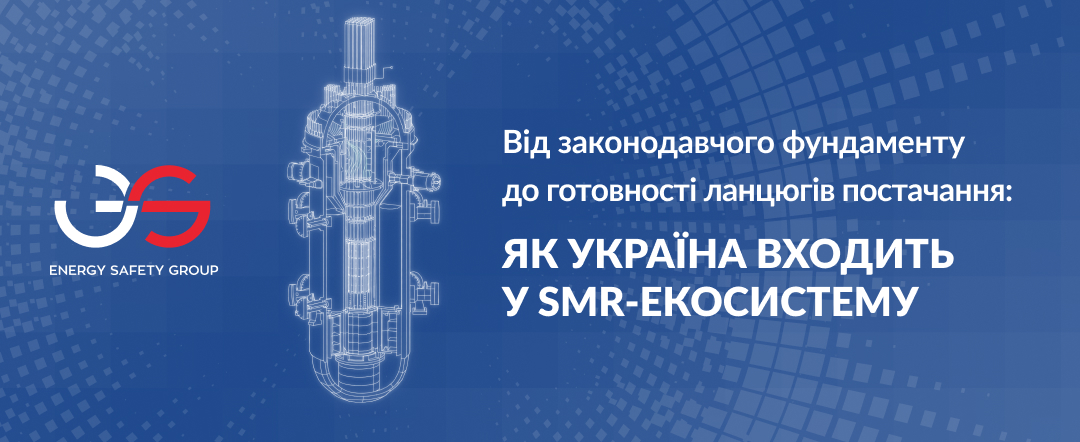
MOVING FROM LEGISLATIVE FRAMEWORK TO SUPPLY CHAIN READINESS: HOW UKRAINE ENTERS THE SMR ECOSYSTEM
Recently, the Center for Information, Analytical and Technical Support for Monitoring of Nuclear Energy Facilities of the National Academy of Sciences of Ukraine (CIATSMNEF NASU) reached out to the Energy Safety Group with a proposal to take part in a survey within the framework of the international initiative for the preparation and development of nuclear supply chains for small modular reactors – Nuclear Supply Chain Priming Initiative.
On the face of it, this is just a survey. On closer inspection, it is an important marker of systemic changes that are gradually taking place in the Ukrainian nuclear industry.
In international practice, the development of SMR technologies is not considered an alternative to classical nuclear generation but rather an addition to the energy mix, capable of addressing several systemic challenges simultaneously.
Firstly, SMR is an important component of decarbonization. According to the Intergovernmental Panel on Climate Change (IPCC), to limit global warming to 1.5°C, the global energy sector must be almost completely decarbonized by 2050. This can only be achieved by combining renewable energy sources with carbon-free baseload capacity, particularly nuclear power. Thus, SMR is seen as a flexible and scalable solution in this context.
Secondly, SMRs increase energy sustainability and safety. Modularity, the phased introduction of capacity, and a wider range of deployment scenarios (in particular on existing industrial sites) make SMRs relevant for countries restoring or transforming their energy systems. For Ukraine, this issue is particularly relevant against the backdrop of constant shelling of energy infrastructure and the need to not only timely restore but also to structurally rebuild the energy system, taking into account the requirements of sustainability, safety, and decentralization. In this context, SMRs are considered a technological solution that can combine capacity restoration with increased long-term energy reliability.
Thirdly, the development of SMR stimulates the technological, engineering and scientific ecosystem. International research links SMR to the development of:
- new approaches to safety assessment;
- innovative control and diagnostic systems;
- automated solutions in the field of safety management;
- modern materials and fuels for longer fuel campaigns.
For Ukraine in general and for us, as a full-fledged EPC contractor, this is a clear signal that the state, international institutions and the scientific community are moving from declarations to the conscious formation of capabilities and production capacities capable of providing a greater share of both the domestic and global nuclear markets. Particularly in the SMR segment, which is increasingly being considered as a technology for energy sustainability and decarbonization.
It is important to note that this process already has institutional support. Draft law No. 14164, which forms the legal basis for the development of small modular reactors in Ukraine, has been submitted to the Verkhovna Rada of Ukraine. The draft law contains the following:
- the definition of SMR, and the basic and legal principles of their application;
- proposals for amendments to the laws «On the use of nuclear energy and radiation safety» and «On allowing activities in the field of nuclear energy use»;
- simplified siting and licensing procedures, the possibility of repurposing industrial sites (in particular, thermal power plants/CHP), as well as attracting private investment.
The key objective of the draft law is to create a predictable environment for the construction, licensing, and operation of SMRs, stimulate public-private partnerships, and lay the foundation for the development of national supply chains, competencies, and technologies.
In this context, the survey by the CIATSMNEF NASU within the framework of the Nuclear Supply Chain Priming Initiative seems to be a logical next step. It signals that the process is moving in the right sequence: from the legislative foundation to the practical matters of project management, quality and supply chains in the nuclear industry. It is at this stage that the role of industrial EPC players becomes critical.
Energy Safety Group has practical experience in interacting with regulatory authorities, as well as the status of an accredited supplier for a number of customers in the nuclear sector. The company works with nuclear projects at the levels of engineering, production, documentation and safety.
In particular, we have experience in:
- manufacturing equipment for nuclear power plants, including:
- valves,
- pressure vessels,
- tanks,
- heat exchangers;
- supply and integration of critical systems:
- safety systems,
- systems of technological process management,
- emergency power supply systems,
- heat removal systems,
- solutions for preventing and managing severe accidents.
A separate department is engineering and scientific and technical work for nuclear power plants:
- safety substantiation and extension of operating life;
- assessment of the technical condition of equipment using deterministic and probabilistic methods;
- thermal-hydraulic, strength, seismic, neutron-physical and radiation calculations;
- development of design, construction and operational documentation, including the equipment of systems important for safety;
- preparation of regulatory documentation of the operating organization – methods, standards, programs.
Energy Safety Group also has experience in manufacturing equipment according to European and international codes, in particular ASME Section III and ASME Section IV, and is a certified company with valid ISO 9001:2015, ISO 19443, ISO 14001 and ISO 45001 certificates.
Altogether, these factors confirm that Energy Safety Group has the ability to act as a full-fledged EPC contractor in the nuclear supply chain for SMRs both in Ukraine and in other countries that are betting on the development of this technology.
And the Nuclear Supply Chain Priming Initiative is an indicator that Ukraine is beginning to systemically integrate into the global SMR ecosystem, where not only technology, but also trust, standards, quality, and robustness of supply chains come to the forefront.