


ENERGY SAFETY GROUP DISCUSSES KEY SAFETY CHALLENGES AT AN INTERNATIONAL CONFERENCE IN KHARKIV
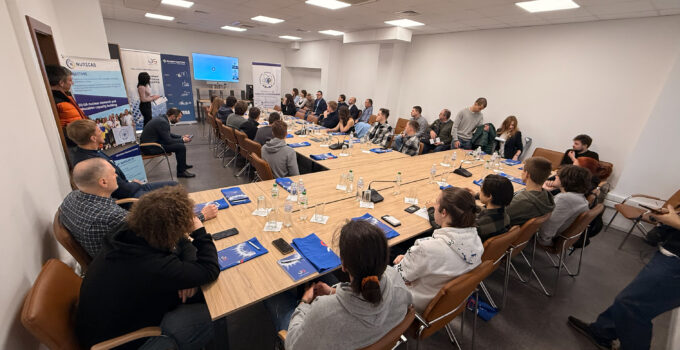
On April 15–17, 2026, the 3rd The V.M. Voevodin International Scientific and Technical Conference «Problems of modern nuclear energy» was held in Kharkiv. The event brought together the scientific community, energy company representatives, and relevant institutions to discuss key challenges facing the industry’s development. The event took place at the «YermilovCentre» Center for Contemporary Art of V. N. Karazin Kharkiv National University, as well as in online sessions.
The conference was organised by the Ukrainian Nuclear Society, the National Science Center «Kharkiv Institute of Physics and Technology», and V.N. Karazin Kharkiv National University, with the support of JSC «NNEGC «Energoatom» and the Kharkiv Regional Military Administration. Over the course of three days, the conference program addressed issues related to the development of Ukraine’s nuclear energy sector, improving the safety and operational efficiency of nuclear power plants, managing radioactive waste and spent nuclear fuel, and the latest scientific research in the field.
Energy Safety Group, which also served as a partner for the event and is an active member of the UkrNS NGO participated in the conference as an active contributor to the professional discussion, presenting its own research in the fields of probabilistic safety analysis, the implementation of hydrogen technologies, and the analysis of severe accidents at nuclear power plants. The company’s young specialists presented research results that could potentially be applied at operating nuclear power plants.
In particular, Vladyslav Moroziuk, an Engineer of Thermal-Hydraulic Analysis Group, presented research on the impact of corium spreading models modifications on the results of containment behaviour analysis under severe accident conditions. The presentation showcased the results of an updated model for the MELCOR code, which accounts for the transfer of molten core chemical composition between rooms, change in melting and solidification temperatures depending on chemical composition, and scenarios involving jamming of the reactor shaft containment doors during the ex-vessel phase of a severe accident.
The results of calculations for scenarios involving a complete power loss with operator intervention confirmed that the pressure relief system is sufficient to maintain parameters within design limits; however, they also revealed a critical dependence of the accident progression on the conditions of molten core cooling in the reactor shaft. Separately, it was demonstrated that the condition of the sealed doors significantly affects the spread of the molten core: if they become jammed, localized melting of the concrete occurs, followed by the spread of the molten core. Based on the study results, the need for additional analysis of the molten material layer thickness and consideration of engineering solutions, in particular the use of sacrificial or refractory materials, was emphasized.
Denys Havlichuk, a senior engineer of Probabilistic Safety Assessment (PSA) Group, focused his presentation on approaches to modeling the initiating event “Reactor Pressure Vessel (RPV) rupture” within the VVER-1000 probabilistic safety assessment framework. He pointed out that the traditional approach to assessing this event remains overly conservative: the event frequency is determined using outdated data, and it is assumed that such a scenario immediately leads to severe core damage.
At the same time, according to Denys, as risks from other accidents decrease following the implementation of safety enhancement measures, reactor pressure vessel (RPV) failure accounts for a significantly larger portion of the overall risk profile and becomes one of the dominant contributors. It was specifically emphasized that using outdated approaches and data when estimating the frequency of this event may lead to a formal exceeding of the established safety criteria for new power units. In this context, the necessity of revising current approaches was highlighted, along with the need for in-depth analysis of international experience, incorporation of RPV pressurized thermal shock (PTS) assessment results, and reduction of excessive conservatism to improve the quality of Probabilistic Safety Assessments (PSA) for Ukrainian NPP units.
Anna Topal, an R&D Group Engineer, presented the results of a study examining the impact of a potential hydrogen plant’s operation on the probabilistic safety indicators of Khmelnytskyi NPP Unit 2. The study identified key accident scenarios affecting the power unit; specifically, using the HAZID methodology, the most critical scenario was identified: an explosion in the hydrogen plant’s buffer tank. Such an event could damage the Outdoor Switchgear (OSG) and lead to a Loss of Offsite Power (LOOP), thereby triggering an initiating event.
To assess the consequences, this scenario was conservatively integrated into the unit’s probabilistic model as an external hazard, accounting for specific boundary conditions. The results demonstrated that even under conservative assumptions, the impact on the overall safety level is minimal and does not lead to an exceedance of regulatory criteria. At the same time, it was emphasized that further model refinement is necessary to reduce conservatism and transition toward a more realistic risk assessment.
In addition to participating in the scientific program, the Energy Safety Group also contributed to shaping the content of the professional discussions held during the conference. The company’s CTO, Oleksandr Mazurok, moderated two key thematic panels: «Development of Ukraine’s Nuclear Energy Sector» and «Improving the Safety and Operational Efficiency of NPP`s». It is precisely these areas that today define both the strategic role of nuclear energy in restoring the power system and practical approaches to ensuring its resilience in the face of new risks.
During these sessions, participants discussed the development of new technologies, the modernization of existing power units, the implementation of modern safety standards, and the integration of the Ukrainian sector into the European energy space. Speakers included representatives from research institutions, JSC «NNEGC «Energoatom», specialized enterprises, and international cooperation programs, ensuring a combination of applied and scientific approaches to addressing industry challenges.
«Today, safety in the nuclear energy sector is not just about compliance with regulatory requirements, but about the ability to systematically manage risks, uncertainties, and scenarios that go beyond design conditions. Conferences like this create an environment where this expertise comes together and transforms into practical solutions», noted Oleksandr Mazurok, CTO of Energy Safety Group.
Energy Safety Group continues to actively engage with professional platforms that shape the nuclear energy development agenda, combining engineering practice, analytical expertise, and participation in international dialogue on the safety and resilience of energy systems.