

INTEGRATION INTO THE EUROPEAN ENGINEERING EDUCATION ECOSYSTEM: ENERGY SAFETY GROUP HAS JOINED THE ENEN NETWORK
The European nuclear sector is entering a new phase of development. With the resurgence of interest in nuclear energy, the focus is shifting not only to technological advancement but also to the training of specialists capable of addressing new engineering, safety and analytical challenges.
This is precisely why professional environments where education, science and industry come together are becoming increasingly important. One such platform is the European Nuclear Education Network (ENEN), which brings together universities, research centres and companies to promote the development of nuclear education, training and professional competencies.
The NESTet 2026 conference took place in Brussels on 2–4 March 2026, supported by ENS and ENEN. The event also featured the ENEN Exhibition, where the Energy Safety Group presented a poster and took part in professional discussions with European colleagues. In addition to information about the company’s activities, the poster also highlighted the issues of Russian nuclear terrorism, the occupation and de-occupation of the Chornobyl exclusion zone, as well as the situation surrounding the occupation of the Zaporizhzhia NPP.
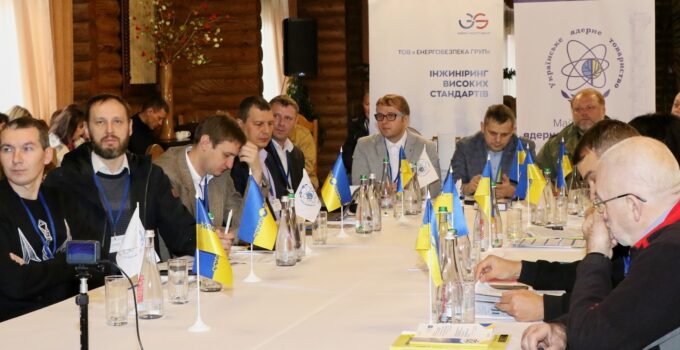
On 4 March, a working meeting entitled «Ukraine’s Nuclear Sector under War Conditions», held as part of the NURECAB initiative, formed a separate part of the programme. It focused on the development of the Ukrainian nuclear sector in wartime, cooperation with European partners, and the role of education in training specialists. Participants in the events included representatives of the Ukrainian professional community, in particular the UkrNS NGO, as well as universities and research institutions — Taras Shevchenko National University of Kyiv, the National Science Center «Kharkiv Institute of Physics and Technology», Odesa National Polytechnic University, National Technical University of Ukraine «Igor Sikorsky Polytechnic Institute», and V. N. Karazin Kharkiv National University.
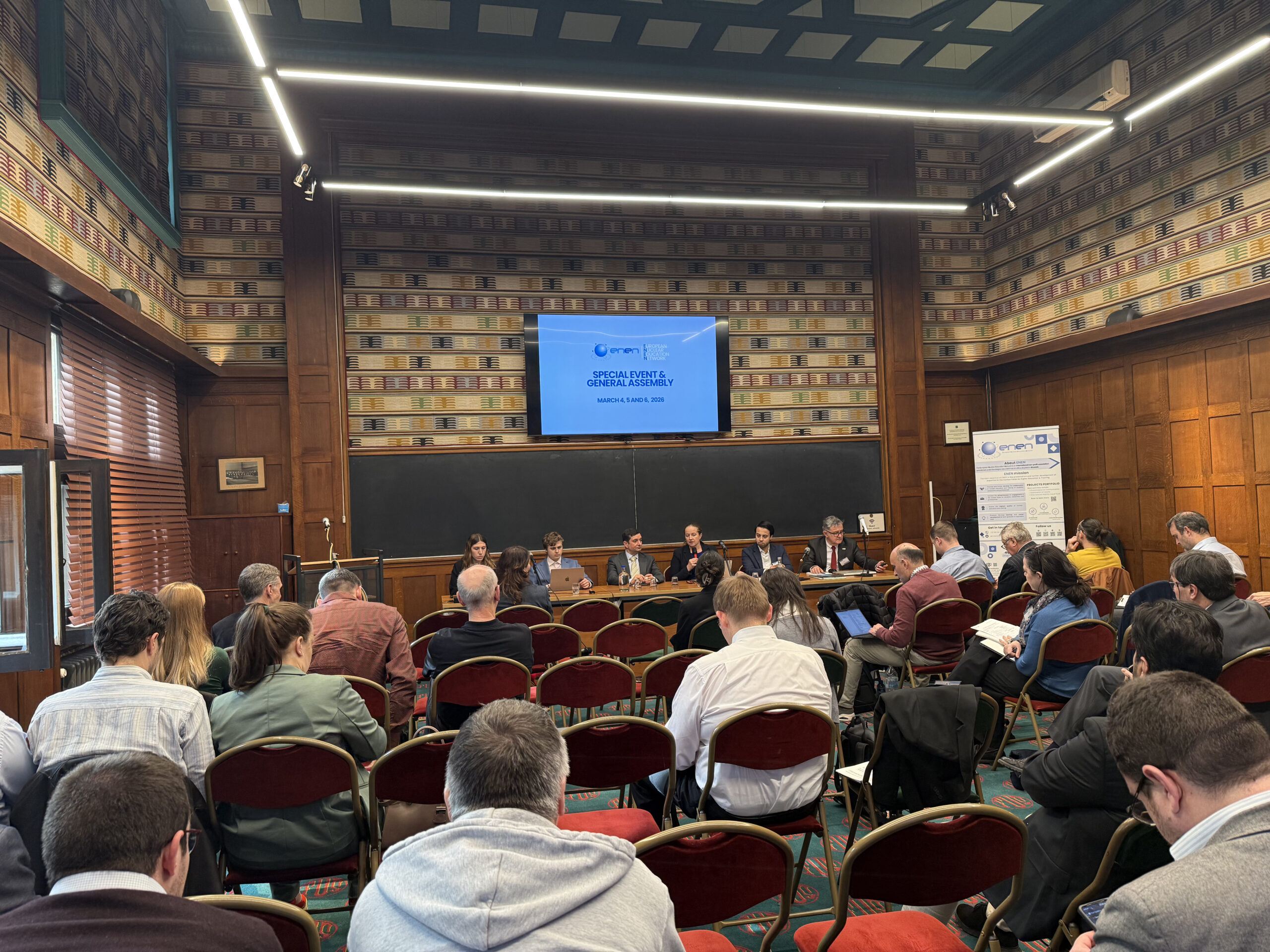
The ENEN Annual Event and the 10th ENEN General Assembly took place on 5–6 March. The first day was devoted to internal discussions and presentations for network members, whilst during the General Assembly, Energy Safety Group presented its activities and, following a vote, was admitted as a member of ENEN.
Hanna Meleshko, Senior Engineer of R&D Group, explains what the company gained from this trip, what signals the European market is sending, and how the Energy Safety Group sees its future development in this context.
— Hanna, what did it mean for Energy Safety Group to be represented at ENEN level and subsequently join the network?
— For us, this was an important professional step. ENEN brings together a community that discusses the development of nuclear education, the training of specialists, new approaches to teaching, and collaboration between universities, research centres, and companies.
During the General Assembly, we presented the Energy Safety Group, spoke about the company’s areas of work, our experience in implementing complex projects, as well as in the field of deterministic and probabilistic safety analysis, design justification and engineering support, and our approaches to human resources management and working with young people. Following this, the company was admitted to the network by a vote of the network’s members.
For us, this means integration into the European professional community not only as members but also as sources of expertise — with the opportunity not only to train our own specialists but also to act as lecturers and share practical experience. This enhances the company’s visibility in the European market and creates the conditions for participation in international projects.
— Why is this important for the Energy Safety Group?
— First and foremost, it provides access to educational programmes, training courses, schools and professional contacts within ENEN.
It is also worth highlighting personnel training in the nuclear energy sector and its integration into the European professional community. At the events in Brussels, the results of work in this area were presented — in particular, a gap analysis of specialist training, updates to training courses, and approaches to integrating Ukrainian institutions into European research and education networks, including Euratom programmes. This provides a better understanding of how engineering training is structured in Europe and how we can be part of these processes.
For the Energy Safety Group, this area is also important because, through such initiatives, we want to contribute to the development of teaching materials and tell students more about the company’s activities, show what real-world engineering practice looks like, and involve young professionals in internships and work placements whilst they are still studying.
If there is a continuation of the NURECAB-2 format, this will be an opportunity for us to become a useful platform for cooperation among the company, universities, and future engineers.
— You had the opportunity to attend some of the open sessions during the NESTet 2026 conference. What did you find particularly interesting?
— For me, it was a great opportunity to see how different countries approach staffing and education issues within the sector.
At NESTet, there was a lot of discussion about skills and competencies, training young professionals, developing career paths, and making the sector more accessible and attractive to young people. The programme included separate sessions on the development of the nuclear workforce, lifelong learning, certification, and the link between education and industry needs.
It was interesting to see the approaches of different countries and institutions. For example, the programme included representatives from France, who presented an approach to developing a talent ecosystem for the nuclear sector and continuous learning; Italy — educational pathways and student engagement with industry; Spain — digital education and safety culture training; and Saudi Arabia — an interdisciplinary model for training personnel in the nuclear sector, despite the fact that the country has no operational nuclear power plants.
It was particularly important to see our Ukrainian colleagues. The programme featured, in particular, the Ukrainian Nuclear Society, Taras Shevchenko National University of Kyiv, the National Science Center «Kharkiv Institute of Physics and Technology», the National Technical University of Ukraine «Igor Sikorsky Polytechnic Institute» V. N. Karazin Kharkiv National University. This demonstrates that the Ukrainian educational and scientific community is a significant part of this platform.
— How did the poster session go, and which discussions did you find most insightful?
— The poster session gave us the opportunity to have a relaxed and focused discussion with colleagues about exactly what Energy Safety Group does and in which areas we can be of assistance.
Several conversations stood out. In particular, after the presentation, a French colleague approached me — he was interested in how exactly we work with analytics, calculations and project support, from the decision-making stage right through to commissioning.
The conversation with our Italian colleagues was more focused: their main area of work is the adaptation of deterministic analysis for small modular reactors (SMRs), which they are already implementing as part of the SASPAM-SA project. We discussed that our company has experience conducting deterministic analyses for large-scale nuclear power units and is currently developing the SMR sector, so it was important for us to understand the results they have already achieved in their project and the approaches they are using. Based on the results of this work, they are considering the possibility of holding a separate training session, and for us, this could become an additional point of interaction.
A separate discussion took place with a representative from RoPower Nuclear, who was interested in our analytical approaches and experience in delivering EPC projects, which could be useful in future MMR projects. In particular, they were interested in our approaches to deterministic and probabilistic safety analyses.
For us, this was important not merely as a ‘general introduction’, but as an indication that our expertise is recognised and generates genuine interest.
— What overall conclusion did you draw from this trip?
— The main conclusion for me is that there is a growing demand in Europe not just for technology, but for people and expertise. And that is precisely why it is important for companies not only to develop their own expertise, but also to work with future specialists at the university level, through work placements, internships and career guidance.
For Energy Safety Group, this is entirely in line with our vision. We are interested in developing a strong engineering team, in selecting and nurturing specialists who can tackle complex tasks — from safety analytics to sophisticated engineering solutions and EPC projects. That is precisely why such international professional platforms are important to us not merely as events, but as part of a longer-term endeavour — one that focuses on knowledge, people and future projects.